

The history
Born in a lab.
Bred on the job.
Polyurea began as an industrial experiment in a Texas laboratory in the late 1980s. Forty years later, NTX is bringing it somewhere it has never been — inside the home.
The report on this site
The chemist who pioneered spray polyurea
inspected our work.
The independent inspection published on this site was written by Dudley J. Primeaux II — the chemist widely credited with inventing spray-applied polyurea, and holder of the process patents that carried it out of the laboratory. He looked at a live NTX deck installation, ran ASTM-standard tests, and wrote the three words we’re proud to print: sound installation.
The inventor of the material, on the record — 24 August 2026
How it was made
Sixty years of quiet chemistry,
then a sprint.
1937
The family tree
In Germany, Otto Bayer synthesizes polyurethane — the polymer family that will one day branch into polyurea. It takes half a century for the branch to bear its own name.
1986
A chemist in Texas
Dudley J. Primeaux II begins development of a two-component, fast-setting polyurea spray at Texaco Chemical. The chemistry is original: an amine and an isocyanate that react in seconds — at the nozzle, not in a bucket.
1988
The first systems reach the field
Polyurea's first spray-applied systems are introduced to industry: 100% solids, no solvents, curing in moments instead of days. Nothing like it has spooled out of a spray gun before.
1989–90s
Patents, and the equipment to prove them
Primeaux is named inventor on a family of polyurea patents. Plural-component rigs mature to match the chemistry's speed, and polyurea spreads — truck beds, tank linings, pipelines, containment, industrial floors.
2000
The industry organizes
The Polyurea Development Association is founded. What started as one chemist's obsession is now a technology with its own standards, its own research, and a global install base.
2000s–10s
The hard places adopt it
Bridges, blast mitigation, stadiums, sewers, marine infrastructure — the harshest environments on the continent start specifying polyurea where nothing else has held.
Today
Still not a DIY material
Polyurea requires heated plural-component machines, precise ratios, and trained hands. That is exactly why so few crews touch it — and why the work has never gone routine.
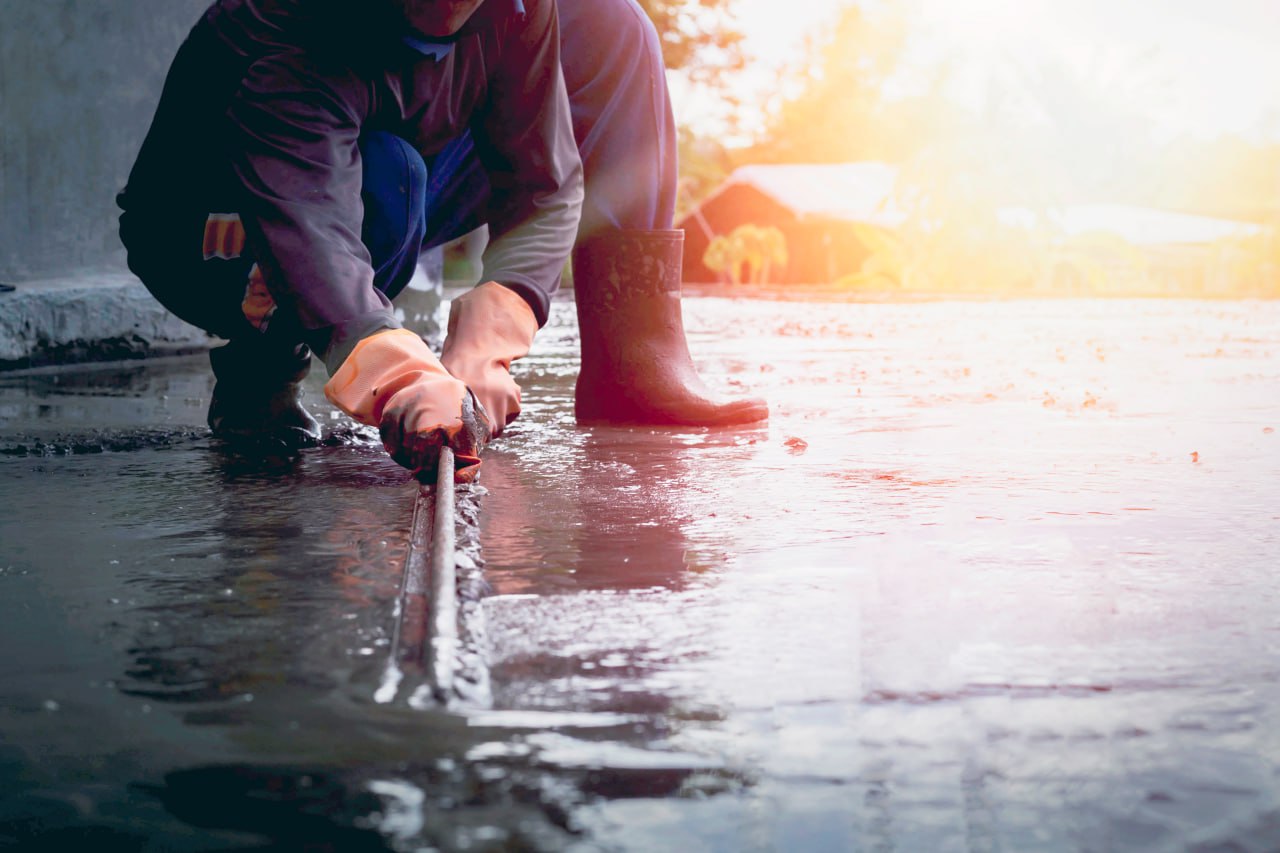
The work · in the field
On the membrane, before the finished world is built on top.
The NTX chapter
To our knowledge, the first crew
to take it inside.
Polyurea conquered exterior work decades ago — decks, roofs, foundations, the harshest industrial environments on the continent. But those are places you can tear into if you have to. The shower is different: a leak there means tearing out the stone, the tile, the glass you fell in love with.
So NTX took the material where it had never needed to go — inside the finished home. We spray the same industrial systems the oil fields run — ArmorThane and Marvel — as one monolithic membrane behind your finishes. Showers. Elevated decks. The places water is certain to attack. As far as we can tell, nobody had done that before.
- Showers — the tile is the top coat; the membrane is the warranty.
- Elevated decks that move with the house instead of cracking.
- Wherever a WRB was going to be the whole defense.
The next frontier — for window installers
A window never leaks at the glass.
It leaks at the flashing.
Installers do excellent work — then the window-to-frame joint trusts a piece of flashing tape to be the whole defense. Tape ages, tape fails in the cold, and tape has to make good at its own seams. That is the weak link in every window ever installed.
Our idea for the window crews: after you set the unit, NTX comes back and sprays the window flanges to the sheathing with polyurea. The joint becomes one monolithic bond with the plywood — a single seamless membrane, no longer counting on flashing to do the trick. If you install windows in North Texas, you’ve got a partner for the part of the detail nobody wants to own.
The story isn’t finished.
Your project is the next chapter.